


Employer of Record in South Korea: Hire, Manage, and Pay Talent Seamlessly
Get StartedFrom onboarding to payroll management, Tarmack's EOR services make hiring in South Korea fast, compliant, and cost-effective.
Employment Norms in South Korea
South Korea is a highly industrialized nation in East Asia and is considered one of the world's leading economies. As such, its employment norms have become a topic of interest for those who are keen on understanding the country's labor market.
General Information:
- The South Korean currency is the South Korean Won (KRW).
- Seoul is the capital of South Korea.
- Korean is the official language of South Korea. English is also widely spoken in the country. Documentation can be in Korean or English to be considered legally valid.
- As of 2021, the GDP of South Korea was reported to be USD 1.81 trillion.
South Korea's labor laws protect workers' rights, covering areas such as minimum wage, working hours, overtime, and discrimination.
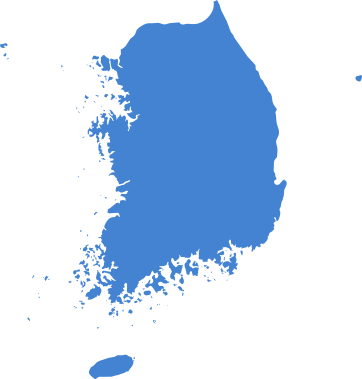
Table of Contents
- Agreements
- Onboarding Process
- Visa
- Minimum Wage
- Payroll Cycle
- Annual Bonus
- Health Benefits
- Working Hours and Overtime
- Leaves
- Social Security
- Taxes for Employers
- Taxes for Employees
- Probation
- Termination
- Severance Pay
- Employees or Contractors
- Final Words
AgreementsOnboarding ProcessVisaMinimum WagePayroll CycleAnnual BonusHealth BenefitsWorking Hours and OvertimeLeavesSocial SecurityTaxes for EmployersTaxes for EmployeesProbationTerminationSeverance PayEmployees or ContractorsFinal Words


Agreements in South Korea
South Korea has entered into numerous international agreements that impact its labor market.
- South Korea has a free trade agreement (FTA) with the United States, which includes labor provisions that aim to protect workers' rights and promote decent work conditions.
- South Korea is also a member of the International Labor Organization (ILO), an agency of the United Nations that sets international labor standards and promotes decent work.
- In addition, it has entered into various bilateral and multilateral agreements with other countries that cover labor and employment issues.
- These agreements often specify the language in which they are written. These can be Korean, English, or both, depending on the parties involved.

Onboarding Process in South Korea
Here are some key points related to the employee onboarding process in South Korea:
- Employers are required to collect a range of documents from employees during the onboarding process, including identification documents, tax information, and proof of education or qualifications.
- Employers should also provide new employees with information about the company's policies, procedures, and benefits, as well as their job responsibilities and expectations.
- While there are no established laws or regulations governing the onboarding process in South Korea, best practices include providing a comprehensive orientation program, assigning a mentor or buddy to new employees, and conducting regular check-ins.
Hire International Employees Compliantly
Get Started
Visa in South Korea
South Korea has several types of work visas that foreign workers can apply for. Here are some of the most common types:
- E-1 Visa: For foreign nationals coming to South Korea to engage in international trade activities.
- E-2 Visa: For foreign nationals coming to South Korea to teach English at a public or private institution.
- E-7 Visa: For foreign nationals coming to South Korea to work in a specialized field, such as engineering or IT.
- D-8 Visa: For foreign nationals coming to South Korea to invest in a business.

Minimum Wage in South Korea
As of 2023, the minimum wage in South Korea is 9,620 won per hour.

Payroll Cycle in South Korea
In South Korea, the payroll cycle is typically monthly.
Streamline Global Payroll Instantly
Explore Payroll
Annual Bonus in South Korea
In South Korea, it is common for employers to provide their employees with an annual bonus, typically at the end of the year. While there is no specific legislation governing annual bonuses, it is a common practice across many industries.

Health Benefits in South Korea
Here are some of the common health benefits that employers in South Korea may offer to their employees:
- National health insurance: South Korea has a national health insurance system that provides basic coverage to all citizens and legal residents. Employers are required by law to enroll their employees in the national health insurance program.
- Additional health insurance: Some employers may also offer additional health insurance benefits to their employees, such as private health insurance or supplemental coverage for dental or vision care.
- Wellness programs: Employers may also offer wellness programs or other initiatives aimed at promoting employee health and well-being

Working Hours and Overtime in South Korea
- Work hours: The standard workweek is 40 hours
- Break: Under South Korean law, employees are entitled to a 1-hour break for every 8 hours worked.
- Overtime: Employees who work more than 40 hours per week are entitled to overtime pay, which is typically 1.5 times their regular hourly rate.

Leaves in South Korea
Sick Leave
- There are no statutory sick leave entitlements in South Korea.
- Employees are entitled to three months of paid leave for any work-related injury. The paid leave is equivalent to 70.00% of the employee's regular salary.
Parental leaves
- The maternity leave period is 90 days, increasing to 120 days for multiple/complicated births in South Korea.
- Maternity leave can be taken 45 days before the due date and 45 days after.
- The maternity leave is paid by social security and the employer combined.
- Fathers are entitled to 10 days of mandatory paid paternity leave, with five days paid by the employer and five days by the social security/government.
- Parents of children under 8 can request up to one year of full-time or part-time childcare leave, with an allowance paid by social security.
Annual leaves
- Employees in South Korea are entitled to at least 11 days of paid annual leave per year. This increases with years of service, up to a maximum of 25 days per year.
Public Holidays (for the Calendar year 2024)
Some dates may vary based on official notifications and traditional calendars.
- New Year's Day - 1st January
- Seollal (Korean Lunar New Year's Day) - 9th to 11th February
- Independence Movement Day - 1st March
- Children's Day - 5th May
- Buddha's Birthday - 15th May
- Memorial Day - 6th June
- Liberation Day - 15th August
- Chuseok (Korean Thanksgiving Day) - 16th to 18th September
- National Foundation Day - 3rd October
- Hangul Day - 9th October
- Christmas Day - 25th December
Public Holidays (for the Calendar year 2025)
Some dates may vary based on official notifications and traditional calendars.
- New Year's Day - 1st January
- Seollal (Korean Lunar New Year's Day) - 28th to 30th January
- Independence Movement Day - 1st March
- Children's Day - 5th May
- Buddha's Birthday - 5th May
- Memorial Day - 6th June
- Liberation Day - 15th August
- Chuseok (Korean Thanksgiving Day) - 5th to 7th October
- National Foundation Day - 3rd October
- Hangul Day - 9th October
- Christmas Day - 25th December

Taxes for Employers in South Korea
Employers in South Korea are required to pay several taxes, including:
- National Pension Insurance: Employers are required to pay 4.5% of the employee's salary to the National Pension Insurance. The employee is also required to contribute 4.5% of their salary to this scheme. Monthly contribution capped at 248,850.
- Health Insurance: Employers must also contribute to the National Health Insurance scheme, which is mandatory for all employees. The employer pays around 3.54% of the employee's salary towards this scheme.
- Employment Insurance: Employers are required to pay 1.15%-1.75% of the employee's salary towards the Employment Insurance program, which provides unemployment benefits to eligible employees.
- Worker Accident Compensation Insurance: Employers are required to pay for insurance that covers any work-related injuries or accidents that their employees may face. The is 0.7-18.6%
- Long-term care insurance: 0.45%
- Resident tax: 0.5%
- Corporate Income Tax: Employers are required to pay corporate income tax on their profits. The corporate income tax rate is currently 10%.

Taxes for Employees in South Korea
Employees are required to pay several taxes, including:
- National Pension Insurance: All employees are required to contribute 4.5% of their salary to the National Pension Insurance scheme. Employers are also required to contribute 4.5% of the employee's salary to this scheme. Monthly contribution capped at 248,850.
- Health Insurance: All employees are required to contribute to the National Health Insurance scheme, which provides health benefits to eligible employees. The employee contribution amount is 3.545%
- Income Tax: Employees are required to pay income tax on their earnings. The income tax rate is progressive and ranges from 6% to 45% depending on the employee's income level.
- Long-Term Care Insurance: 0.45%
- Employment Insurance: 0.90%
- VAT: Standard rate of 10%
Calculate True Employee Costs Now
Calculate Now
Probation in South Korea
The duration of the probation period can vary depending on the employer and the nature of the job, but it typically ranges from 30 to 90 days.

Termination in South Korea
An employer can terminate an employee for various reasons, including but not limited to:
- The employee's poor performance or misconduct
- The expiration of the employment contract
- The mutual agreement of the employer and employee to terminate the employment relationship

Severance Pay in South Korea
In South Korea, employers are required by law to provide severance pay to employees who have completed at least one year of service with the company. The amount of severance pay is based on the employee's length of service and monthly salary, and it is one month for every year of service.

Employees or Contractors in South Korea
In South Korea, misclassifying an employee as a contractor or vice versa can result in legal penalties and fines.
- Employers who misclassify employees as independent contractors may be required to pay back wages and benefits, as well as face fines and other legal consequences.
- Additionally, employees who are misclassified as contractors may not receive certain legal protections and benefits that are afforded to employees.

Final Words
In conclusion, South Korea has a well-established legal framework governing employment norms and regulations. The country provides many opportunities for businesses and individuals, with a highly skilled workforce and a thriving economy. While there are strict labor laws in place, they provide important protections for workers and ensure that employers comply with legal requirements.
See Transparent EOR Pricing
View PricingExplore Hiring & Payroll In Other Countries
Employer of Record in United StatesEmployer of Record in SingaporeEmployer of Record in IsraelEmployer of Record in PortugalEmployer of Record in LatviaEmployer of Record in CanadaEmployer of Record in FinlandEmployer of Record in United Arab EmiratesEmployer of Record in MaltaEmployer of Record in ChileEmployer of Record in AustraliaEmployer of Record in New ZealandEmployer of Record in QatarEmployer of Record in GreeceEmployer of Record in MalaysiaEmployer of Record in GermanyEmployer of Record in IrelandEmployer of Record in Saudi ArabiaEmployer of Record in EstoniaEmployer of Record in South AfricaEmployer of Record in United KingdomEmployer of Record in LuxembourgEmployer of Record in Hong KongEmployer of Record in Czech RepublicEmployer of Record in BrazilEmployer of Record in SwitzerlandEmployer of Record in FranceEmployer of Record in TaiwanEmployer of Record in PolandEmployer of Record in MexicoEmployer of Record in SwedenEmployer of Record in BelgiumEmployer of Record in PhilippinesEmployer of Record in ArgentinaEmployer of Record in NorwayEmployer of Record in AustriaEmployer of Record in CyprusEmployer of Record in HungaryEmployer of Record in ThailandEmployer of Record in DenmarkEmployer of Record in JapanEmployer of Record in SpainEmployer of Record in SlovakiaEmployer of Record in ChinaEmployer of Record in NetherlandsEmployer of Record in ItalyEmployer of Record in LithuaniaEmployer of Record in India
+ 38 moreA truly global HR platform with everything you need to build, grow & manage a global team.
- Identifying & recruiting the best talent
- Payroll with full compliance across 100+ countries
- Employment agreements as per local laws
- Contractor invoices & time management
- Smooth remote onboarding of employees
- Immigration & mobility services around the world





Social Security in South Korea